Stop Pitch Slapping on your first call
/
Over 18 years of sales development it not usual for salespeople to ask me to assist them in improving their out reach calling. Here are some things to consider - don’t pitch slap them
Read More
Discover SG Partners latest blog articles. Learn from a wide range of topics including sales, leadership, emotional intelligence and sales team recruitment. The best information you'll read today.
Over 18 years of sales development it not usual for salespeople to ask me to assist them in improving their out reach calling. Here are some things to consider - don’t pitch slap them
Read MoreToo many salespeople need to be liked - need people’s approval
The impact is they will not ask great questions, they will not ask for the deal, they crumble when they get pushback.
Too many sales leaders need to be liked - need their salespeople’s approval
The impact is they will not be able to hold them accountable, they will not be able to have great coaching sessions, they will delay performance management.
This video is an interesting way to consider being liked.
Your ability to make effective decisions will not impact your success but those around/who rely on these decisions - are you aware of what maybe impacting your decision making?
Read MoreYour ability to make effective decisions will not impact your success but those around/who rely on these decisions - are you aware of what maybe impacting your decision making?
Read MoreWhat is a great sales leader? Most leaders have not met one. Most sales people have not experienced one. Most sales leader are not one.
Read MoreDo your people really understand you? Understand where you want to go and how you will get there with their help?
Do you really have alignment to your goals/ambitions? How would you know?
Recently I have been assisting a client with their growth ambitions.
We teased out what these were in a strategy session with the leadership team. We articulated the gaps to achieve the said ambitions of the owner.
Now how are we going to work on the gaps. 3 projects were identified.
One of those being a growth culture.
Starts with alignment.
We have been working on 3 guiding principles for the business and the appropriate above and below the line behaviours. When each one was created by the leadership team they then needed to engage their various team members to get their buy in - this has gone very well.
The leadership team thought this was all done - no no no. This is a continual engagement I explained. How are you going to weave this into everyday communication within your team? How is this going to become part of your company language?
It's always risky to oversimplify something as complex as sales management. On the other hand, it can be a great way to cut through and achieve meaningful self-awareness.
Read MoreIt's always risky to oversimplify something as complex as sales management. On the other hand, it can be a great way to cut through and achieve meaningful self-awareness.
Read MoreWhy your best sales people maybe leaving you
I have been recruiting for clients sales team members for 13 years or more and there is the one constant I see and hear from great candidates.
As an employer you have a belief why your employees leave. In this post I share what the constants are
Read MoreIn the time of COVID it’s now easier than ever to conduct sales coaching based upon sales leadership being involved in prospect/client engagements with their sales people.
And yet some are not doing the virtual ride alongs - here is a video revewing the opportunities and some tips
Your sales emails are crtical to your sales effectiveness. How your structure and write these emails will dictate how quickly you will get the desired response.
Emails are part of our communication strategy so let’s take time to understand even more how to be even more sucessful at writing them - read this blog for some insights.
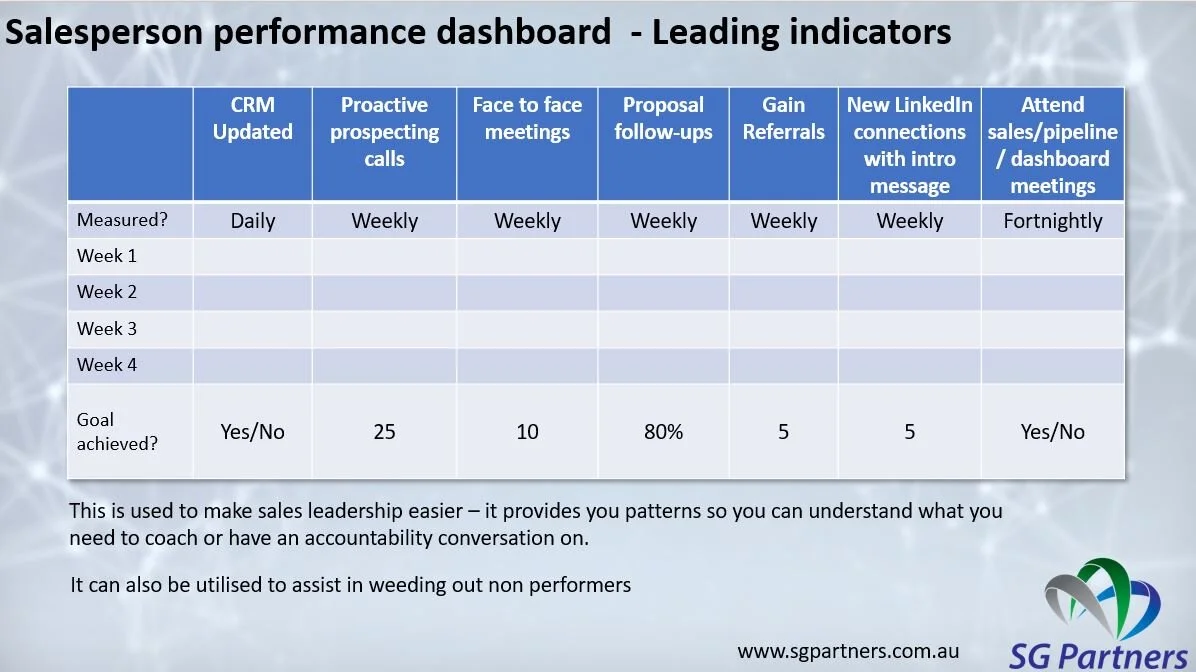
Read MoreIf you have ever wanted to change sales behaviours I bet you discussed, told, bribed (commission and bonus) and even yelled and still not get the change yo are after.
To assist sales leaders in their efforts to drive change we assist them to put into practice positive sales performance dashboards. Check out the blog post
Read MoreThey want to grow.
They don't know whether they have the right salespeople or sales managers to achieve that growth.
They need a better understanding of how to effectively manage their people daily.
They don't know why their salespeople aren't doing what they have been asked to do.
They don't know if their salespeople can do more (or how much more).
Their company isn't exceeding its goals.
Their competition has a better market share.
Their margins have been slipping.
Their salespeople are caught in a "comfort zone".
Management is accepting mediocrity from its sales force.
One of the keys to the success of any program is knowing what we are working with as a first step. SG Partners conduct personalised leadership and sales team evaluations that enable us to tailor-make the change program.
We all know how successful sports stars compete, they practice and play to their strengths. Well, why not take the same attitude to sales? How can you work more effectively with the team you already know and have right now? In doing so, you automatically give yourself a distinct advantage and very likely differentiate yourself. Do you know your sales teams strengths and how to work with them?
Are your people Hunter or Farmer types?
Do they prefer setting the opportunity up rather than closing it?
Who in the team prefers to be more technical rather than consultative sales approach?
The interesting thing is that most salespeople do not know their strengths and potential growth areas. When we assess them and deliver the results, they usually say, "That's me, and wow, I did not know that’s where I play at my best… I normally just do what I do.” You deserve the very best sales team. From acquiring the very best, you can achieve the results you never thought possible.
How easy would it be if you could see your teams proof of skills and abilities?
If you are reading this article, it is likely you play a crucial role in your sales team and are seeking ways to improve your sales team's performance. Fortunately, I have got 6 ideas to improve your sales team, you might not have thought of...
Who is best at developing new business and who is best at managing existing business? Who prefers setting the opportunity up rather than closing it and who is more technical than via application knowledge sales? The interesting thing is that most salespeople do not know their own strengths. When we assess them and deliver the results, they will often say “That’s me, and wow I did not know that was where I play at my best.” If you are aware of their strengths, you can redefine their roles, then plan growth strategies accordingly. Download a free sample of our evaluation here.
Great managers can improve sales team performance by sharing their own experiences with their employees. Enforcing an open-door policy and trading ‘war stories’ with your sales team for learning purposes, will strengthen the culture and increase your salespeople’s’ loyalty and motivation.
There are sales managers out there who believe they need to be liked by their team, others lack skills or the confidence to assert themselves over a salesperson, or they simply do not have the authority to hire and fire and it is leaving their sales team with a lack of direction and accountability.
It is time to get trained on creating and managing KPI’s and processes, and how to hold each salesperson accountable to them. Before you ask, this is not a direct contradiction from, ‘be a mentor, not just a manager’ point. In fact, it directly relates: an army drill soldier can be both an authority figure and mentor, as a sales manager you can too!
Knowing what drives your team and how to reward them correctly could make all the difference. Consider this, in 2007, 54% of the sales force were Extrinsically Motivated, by 2011, this dropped down to just 27%. In 2017, from the most recent 350,000 salespeople assessed, that percentage dropped an additional 70% to just 8%. The shift from Extrinsically (money based) to Intrinsically Motivated (internal reward based) renders commission based bonus-plans a thing of the past.
If you don’t already have one, this is a sheet/checklist that defines your company’s ideal client attributes. Think in terms of size, industry, buying habits, budget, business alignments and situation factors; the list goes on. Once decided, each member of your sales team should be held accountable for memorising this profile thus be able to identify the essential qualities before conducting any business. Align your pursuit of new business with this profile. Over time, as the business grows or changes, so should the ideal client.
Sales have moved on from features and benefits selling. It's changed from ABC – Always Be Closing. It has changed from SPIN – why? Well, guess what, your clients/buyers have moved on and changed, so shouldn’t your team too? I got some questions for you:
Is your sales team selling like they were five years ago?
Using the same show-up and throw-up routine?
STILL meeting/talking to the same level of people they have always done and are comfortable with?
Still believe rapport building is talking about sports for 30 minutes?
If you do not know the answers to these questions – perhaps you should be worried. Answering "Yes" to these questions – you should be worried! Finally, if you were thinking, “What's the problem?” - you're obviously not worried but you SHOULD be terrified! How many will you implement?
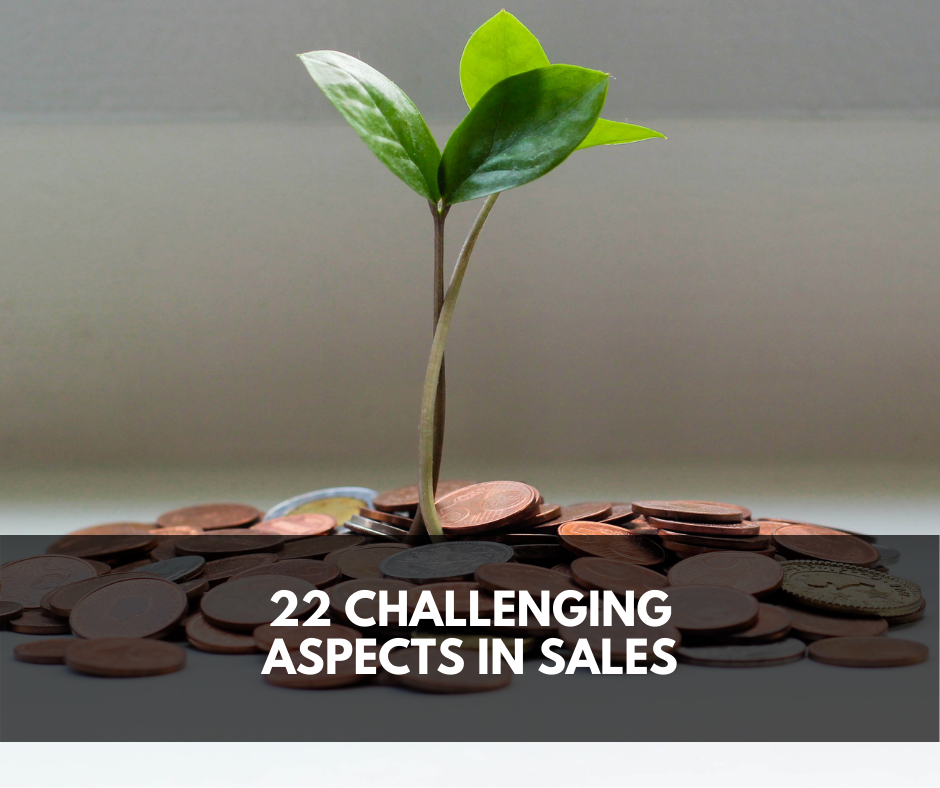
What are the most challenging aspects of sales you experience? Here is a list of 22 challenging aspects of sales you might relate to.
Read More